Ransomware Attack Process and Principles
Publish Date: 2025-01-02
Ransomware attacks have become a significant and evolving threat to organizations of all sizes, demanding a comprehensive understanding of their operational mechanisms to build effective defense strategies. This report provides an in-depth analysis of the typical ransomware attack lifecycle, outlining the various stages from initial access to post-attack recovery. It details the technical procedures employed by attackers, including how they infiltrate networks, move laterally, encrypt data, and make ransom demands. By examining these key aspects, this research aims to equip IT professionals with the knowledge needed to develop robust security measures and respond effectively to such incidents. The goal is to translate complex threat information into actionable insights that can bolster an organization's cyber resilience.
Overview
Key Findings:
Ransomware attacks follow a well-defined pattern that typically starts with gaining initial access to an organization's network, then involves moving laterally to compromise more systems, and culminates in the encryption of critical data to demand a ransom. Attackers often use a combination of techniques to achieve their goals. The initial access phase may include exploiting software vulnerabilities and also tricking users into downloading malicious content.
Attackers employ a variety of methods for initial infiltration, ranging from phishing emails that deceive users into revealing credentials or downloading malware, to exploiting known vulnerabilities in software and operating systems that haven't been patched. These sophisticated techniques often blend social engineering with technical exploits to maximize the chances of a successful breach. This also shows the need for a multilayer approach to security that includes robust user education and technical security measures.
A deep understanding of the encryption methods used in ransomware attacks is crucial for organizations to plan effective recovery strategies, including data backup, disaster recovery, and potential negotiation strategies. Understanding encryption provides key insights for developing mitigation plans, and helps an organization to understand if a recovery through decryption is a feasible strategy.
Recommendations:
To effectively prevent ransomware attacks, organizations must implement a comprehensive suite of security controls designed to block initial access and prevent lateral movement across networks. These controls should include firewalls, intrusion detection systems, strong password policies, and multi-factor authentication (MFA) to secure entry points into an organization's infrastructure.
Regularly backing up critical data and thoroughly testing the recovery process are crucial steps for minimizing the impact of ransomware. This will allow an organization to recover important systems and data without succumbing to ransom demands. Regular tests also provide insights about backup strategy improvements.
Enhancing threat intelligence and developing comprehensive employee awareness programs are crucial for effectively detecting and responding to ransomware threats. Threat intelligence enables organizations to proactively identify indicators of compromise, and security training for employees helps create a human firewall to mitigate threats.
Introduction
Ransomware, a particularly insidious form of malicious software, operates by encrypting a computer system's data, effectively rendering it inaccessible until a ransom is paid to obtain a decryption key. This action essentially holds the organization's critical information hostage. The ramifications of such attacks for organizations are substantial, extending far beyond mere financial losses. These include severe operational disruptions that can halt business activities for extended periods, significant reputational damage leading to a loss of customer trust and market share, and potential legal liabilities resulting from data breaches and regulatory non-compliance. The effects of these attacks are not isolated, and can ripple through an entire organization, severely hindering its ability to conduct business, disrupting essential services, causing long lasting damage to an organization’s value, reputation, and the trust that they have established in the market. The financial implications of a successful ransomware attack can be catastrophic, encompassing not just the ransom payment itself, but also recovery costs, legal fees, and penalties, and loss of revenue from operational downtime.
The complexity of these attacks has experienced a steady and concerning growth, evolving from relatively simple file encryption to sophisticated, multi-stage operations that include complex initial access, lateral movement within networks to spread the infection, privilege escalation to gain higher access to system, and ultimately exfiltration of sensitive data for double extortion. This increasing level of sophistication presents a critical and ongoing challenge to both technical professionals tasked with securing IT infrastructures and business leaders responsible for the overall health and success of their organizations. It requires not just a basic understanding but a deep and nuanced comprehension of the evolving threat landscape, and the ability to adapt and respond to new attack methods and strategies in a proactive, rather than reactive, manner. The ransomware landscape is dynamic and rapidly changes, with threat actors constantly refining their techniques to circumvent existing security measures and exploit new vulnerabilities, requiring vigilance, continuous learning, and a proactive security posture that anticipate potential attacks rather than just reacting to them after they have already occurred.
Analysis
Initial Access and Reconnaissance
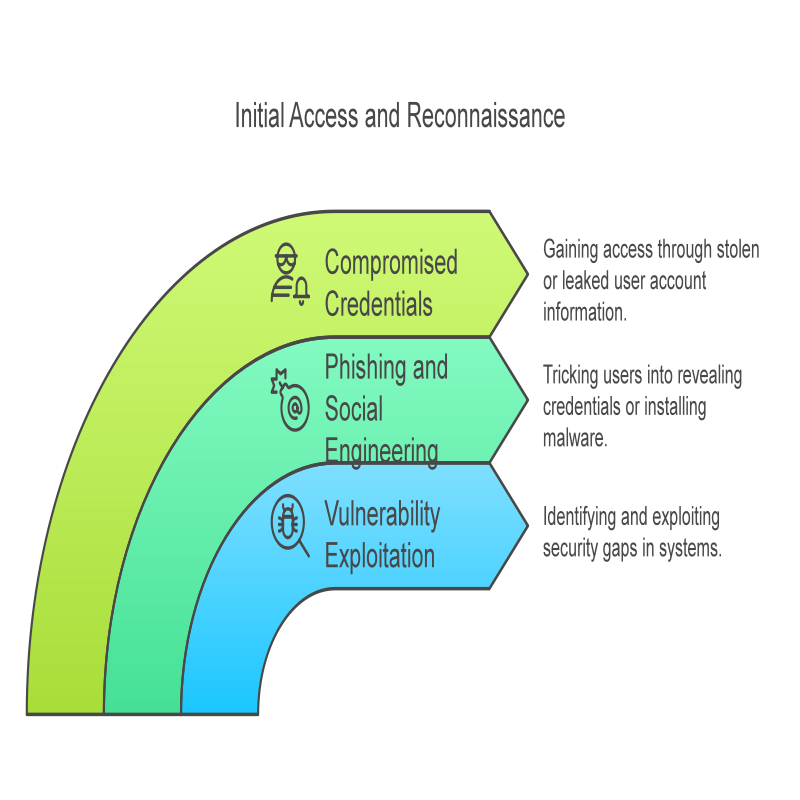
Vulnerability Exploitation
Identifying and exploiting security gaps in systems or software.
Attackers often begin by scanning systems for known vulnerabilities, leveraging tools to rapidly identify weaknesses in software or hardware. These vulnerabilities can be unpatched software flaws, misconfigurations, or outdated systems. The exploitation can range from simple exploits to more sophisticated zero-day attacks, which take advantage of previously unknown flaws. Once a vulnerable entry point is discovered, attackers deploy their payload, establishing an initial foothold into the system. This is not just limited to public-facing systems but includes vulnerabilities within internal network infrastructures as well. Organizations must prioritize timely patching and regular vulnerability assessments to mitigate this risk effectively. It is also vital to continuously monitor for anomalous activities, as this can be an indicator of exploitation attempts. Regular network scans and system analysis are therefore essential.
Using automated tools for rapid discovery of vulnerable assets.
Automated vulnerability scanning tools play a crucial role in the early stages of an attack, allowing threat actors to quickly identify vulnerable assets across large networks. These tools efficiently enumerate systems, applications, and services, uncovering any potential security gaps. They can be used to identify open ports, outdated software versions, misconfigurations, and known exploits. By using these scanning tools, attackers can gain an overview of potential weak points within the targeted infrastructure, enabling a targeted approach that maximizes the chances of successful intrusion. Organizations must utilize similar tools for their own security scans to identify and add